This is the 20th story in a series. Click here to read all parts from the beginning.
After I had tried to describe my dream three times, getting more confused with each try, Ira sensibly suggested a brisk walk to clear the cobwebs—or, as he put it, “to let the swirling waters settle.” He led me along a meandering path to a branch of the nearby creek, over snow that had formed a thick enough crust overnight to keep my unsuitable shoes from getting soaked through again.
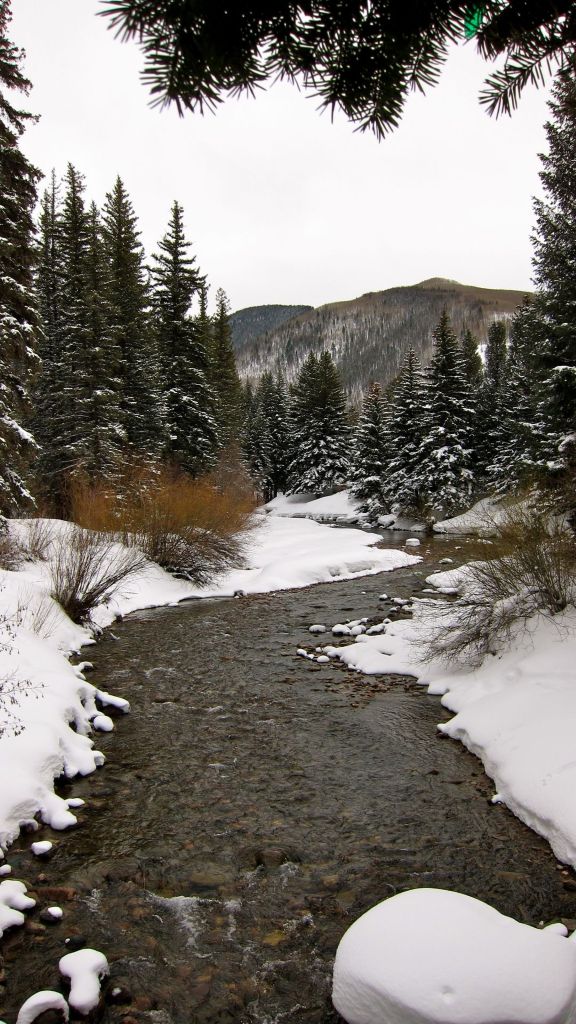
“Was this where the ice serpent came up while you were fishing?” I stayed a few steps behind Ira as he approached the creek, even though I didn’t believe there was much truth to his monster-slaying tales.
Ira knelt beside the creek and used his cupped hands to scoop up water, which he drank before replying. “Not in this place. It’s too shallow for the serpents here.”
Maybe truth didn’t always need to be sorted from tales, I thought, as my mind circled back to the dream—dragons and a magical bridge to the sky.
“When the sorcerers spoke of the need to learn how people and dragons both could live in the world,” I began, making another attempt to explain the dream, “that was hundreds of years ago, wasn’t it? And people spoke many languages then? Is it possible the words might have meant something a little different? Words and stories can change their meaning over many years.”
A twig snapped nearby as a large animal, something like a moose with broad reddish-purple antlers, caught a glimpse of us and bolted deeper into the forest.
“I told you the story exactly as my mother told it to me.” Turning away from the creek, Ira fell into step beside me on the path back to the cabin.
“Where I come from, there’s a word that means something close to what the sorcerers said.” The symbols that made letters on the bumper sticker in my dream gleamed vividly in my thoughts. “Coexist.”
As I said the word, Ira’s language spell rendered it as “together-exist.” The cabin came into view around a turn in the path while I thought about how to explain the concept more clearly.
“It doesn’t just mean living in the same world,” I went on, “or not being at war, or leaving each other alone. It also means learning how to work together so that the world can get better.”
“How can anyone work with dragons? They’re animals.” Ira’s dismissive tone reminded me of Shay when he said catching dragons shouldn’t be that hard of a job.
“My people also think dragons are animals,” I had to acknowledge, “and if my people ever saw you, they’d believe you were an animal—or a monster—just because you don’t look like them. The dragons probably thought your ancestors were monsters for taking fish that they needed to keep themselves and their children well fed. Just yesterday, I had to hide in a drawer all afternoon so I wouldn’t get killed for looking different.”
Passing by his woodpile, which was higher than my head, Ira gave me a handful of dry branches and picked up three much heftier logs himself. He walked on toward the cabin with the same brisk stride, as if barely noticing the weight.
“And you think that I am—a diminisher, I guess, or something of the sort, because I told you that I see myself as not having a gender. But that’s okay, isn’t it, Ira? We’re friends anyway, and we can work together.”
After we got inside the cabin, Ira put down his logs next to the fireplace and took my smaller pieces to start building up the fire.
“We are friends,” he agreed. “I said the words to make it so. That will not change; and we are working together, this morning, if only to carry firewood. Dragons, though—what can be done with them?”
Sparks flew up when Ira put one of the bigger logs on the fire. I almost expected to see visions of magical scenes appearing in the flames, but then I curbed my imagination and brought myself back to the moment before I spoke again.
“Has anyone ever tried to use the friendship and language spells on a dragon?”